TIG welding aluminium: AC, balance and gas

TIG welding aluminium is harder than steel or stainless, but with the right settings and a clean workpiece you get a nice, even weld. It comes down to three things: alternating current (AC), a clean surface and good gas protection.
What do you need to TIG weld aluminium?
- An AC/DC TIG machine. For aluminium you weld on AC, because the alternating current breaks up the oxide layer of the aluminium.
- 100% argon as shielding gas.
- A tungsten electrode of 1.6 or 2.4 mm. Many welders now use a lanthanated or ceriated electrode. Read how to choose the colour.
- Filler rod for aluminium, for example 4043 or 5356. Choose the rod that fits your alloy.
- A gas lens and a slightly larger cup for good gas coverage. Read how to choose the size.
Why is aluminium difficult?
- The oxide layer only melts at about 2000 degrees, while the aluminium itself melts much sooner. That is why you have to remove that layer and break it up while welding.
- Heat: aluminium conducts heat away quickly and you often need more current than for steel. Then it can suddenly burn through.
- Porosity: moisture, grease and oxide quickly cause gas bubbles in the weld.
Preparation
Remove the oxide layer just before welding with a stainless steel brush that you use only for aluminium, then degrease with acetone. Weld within a few hours of cleaning, because the oxide layer forms again quickly.
Settings as a starting point
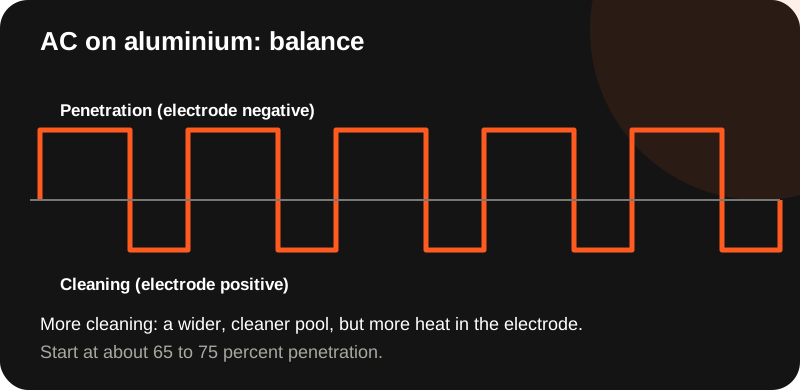
- AC balance: start with about 65 to 75 percent penetration (electrode negative), the rest is cleaning. More cleaning gives a wider, cleaner weld pool, but also more heat in the electrode.
- Frequency: about 100 to 150 Hz. A higher frequency gives a narrower, more focused arc.
- Gas: about eight to twelve litres of argon per minute.
- Current: start with roughly forty to fifty amps per millimetre of material thickness and adjust to what the weld pool does. A foot pedal helps enormously here.
- Electrode: a slightly rounded tip works well on AC. A sharp tip on AC can break up.
The technique
1. Start the arc and wait until the weld pool shines and shows a clear cleaning zone.
2. Add filler at the front edge of the pool and keep the end of the rod inside the gas shield.
3. Work at an even pace. Aluminium gives little warning before it burns through.
4. Fill the crater at the end of the weld by ramping the current down with the pedal.
Common problems
- Porosity or black soot: dirty material or too little gas.
- Burn-through: too much current or too slow.
- Contaminated electrode: you dipped it in the pool. Grind it again.
- No or weak cleaning: the balance is set too low.
Parts that make a difference
Good cups, a gas lens and a clean electrode are extra important on aluminium. Not sure which parts fit your torch? Use our selection guide or send us a message via the contact page.
Want to go over the basics again? Read our complete guide to TIG welding.