TIG welding stainless steel: keep it clean and flat

TIG welding stainless steel gives a clean, precise result, but the material is far more sensitive than mild steel. It conducts heat poorly, distorts quickly and oxidises on the back of the weld if you do not protect it. With a few habits you can weld stainless cleanly.
What do you need to TIG weld stainless steel?
- DC current with the electrode on negative (DC minus).
- 100% argon as shielding gas. This is the safest choice for beginners.
- A tungsten electrode of 1.6 or 2.4 mm, for example lanthanated or ceriated. Read how to choose the colour.
- Filler rod that matches your stainless, for example 308L for 304 and 316L for 316.
- A gas lens for a calm gas flow and better coverage. Read what a gas lens does.
- A TIG cup in the right size. Read how to choose the size.
Preparation
Clean the stainless with acetone or a degreaser. Use brushes and discs that you use only for stainless. A brush that has been used on mild steel carries steel particles that will rust later. Also grind your electrode for stainless only, and keep your filler rod clean.
Settings as a starting point
- Current: start low. Stainless heats up quickly and stays hot, so you usually need less current than for mild steel of the same thickness.
- Gas: about eight to twelve litres of argon per minute. A gas lens helps because the gas flow is calmer.
- Post-flow: let the gas flow well after you stop the arc, about ten seconds or longer on thicker material, so the weld and the electrode cool under protection.
- Electrode: grind a sharp point along the length of the electrode and keep the stick-out short.
The colour of your weld
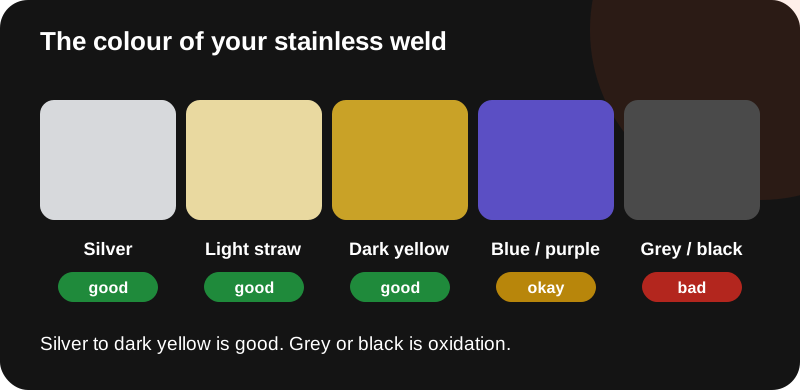
The colour shows whether you welded well:
- Silver, light straw and dark yellow: good.
- Blue or purple: okay. Some extra heat went in, but the weld is usable.
- Grey or black: bad. This is oxidation, often from too little gas or too much heat.
If the weld turns grey or black, you can see right away that the protection was not good. Also read our article on gas coverage when welding titanium: the same principles apply, only stricter.
Protecting the back side (purging)
On full-penetration joints, such as tubes, a grainy grey layer forms on the back side if you do not protect it. This is called sugaring. So also feed argon to the back of the weld so no oxygen reaches it, and seal off the joint as well as you can.
Limiting distortion
- Weld in short steps and let the material cool in between.
- Use clamps or a copper backing bar to draw heat away.
- Keep an even speed and do not let the weld pool sit too long.
Parts that make a difference
Good cups, a gas lens and a clean electrode are extra important on stainless. Not sure which parts fit your torch? Use our selection guide or send us a message via the contact page.
Want to go over the basics again? Read our complete guide to TIG welding.