TIG welding steel: settings, filler and tips

Mild steel is where most welders start, and it is more forgiving than stainless, aluminium or titanium. Still, small mistakes when TIG welding steel make the difference between a clean, strong weld and a porous weld with black edges. Here is what to set up, which filler to use and what to watch for.
What do you need to TIG weld steel?
- DC current with the electrode on negative (DC minus). You do not need AC for steel.
- 100% argon as shielding gas.
- A tungsten electrode of 1.6 or 2.4 mm. Many welders use a grey (WC20) or blue (WL20) electrode. Read how to choose the colour.
- Filler rod for mild steel, for example ER70S-2 or ER70S-6. Choose a diameter that suits your plate thickness, often 1.6 or 2.4 mm.
- A TIG cup that suits your torch and workpiece. Read how to choose the size.
Preparation: clean the steel
Steel often has mill scale, rust, oil or paint. That is the biggest cause of porous welds. Grind or brush the joint and a strip of about two centimetres next to it down to bright metal, and degrease with acetone or brake cleaner. Use a brush or disc that you only use on steel, so you do not carry over stainless particles.
Settings as a starting point
- Current: start with roughly thirty to forty amps per millimetre of plate thickness and adjust to what the weld pool does. A foot pedal makes this easy.
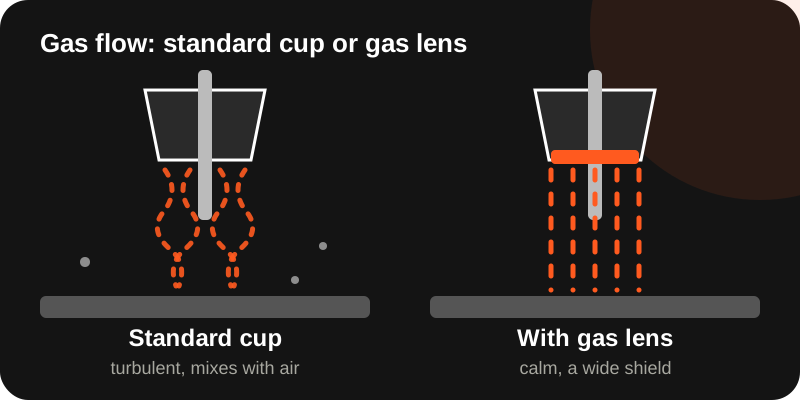
- Gas: about six to ten litres of argon per minute. If you weld outdoors or in a draught, a gas lens helps because it makes the gas flow calmer.
- Electrode: grind a point along the length of the electrode, about two to three times the diameter long. Keep the stick-out as short as possible.
- Post-flow: let the gas keep flowing for a few seconds after you stop the arc, so the weld pool and the electrode cool under protection.
The technique
1. Start the arc and wait for a shiny weld pool.
2. Add filler at the front edge of the pool, not in the arc, and pull the rod back without taking it out of the gas shield.
3. Move at an even speed. A slightly longer arc gives a wider pool; a shorter arc gives more control and deeper penetration.
4. When welding thin sheet, work in short steps and keep the heat under control so the material does not distort.
Common problems
- Pores or a black edge: dirty material, too little gas or a draught. Clean better, check your gas and use a gas lens if needed.
- Black, contaminated electrode: you dipped the electrode in the pool. Grind it again.
- Burn-through: too much current or too slow. Lower the current or speed up.
- Poor penetration: too little current or too long an arc.
Parts that make a difference
Good cups, a gas lens and a sharp, clean electrode make welding steel easier and the weld nicer. Not sure which parts fit your torch? Use our selection guide or send us a message via the contact page.
Want to know more about the basics? Read our complete guide to TIG welding.